Old Stories, New Stories, Our Stories

Did you hear the story about Eutychus, in the book of Acts? He is the youth who fell out of a third story open window late one night while listening to one of the apostle Paul’s very long sermons. (Spoiler alert: he died, but Paul brought him back to life).

         No? How about Deborah, the wise woman who counseled many while she sat under a palm tree … dispensing her wisdom in the midst of the oppression of her people?

         Or, what about the five daughters of Zelophehad, who successfully challenged an unjust law in the highest courts of the land so that they could inherit their father’s land and carry on the family name?

         Some of you may have heard the great Louis Armstrong singing “Shadrac, Meshach and Abednego” (check out this youtube video - Louis Armstrong - Shadrach, Meshach, and Abednego (youtube.com) … but do you know the story from the book of Daniel, when they refused to bow down to a golden idol and ended up in the fiery furnace? (again, spoiler alert: God saved them).

         By now, you know that I love a good story. Whether it is a book, or a movie, or a family story told over the years, I think that stories make up the fabric of our lives.

         A good story helps us to tell our own story, and when we tell our own stories, we get close to our authentic selves – who we truly are in the deepest of our being. When we see ourselves in a story, or relate a story to something we notice in our own lives, we understand ourselves and the world around us a little better.

         Perhaps we notice the people today that are challenging unjust laws, and feel compassion. Or, we are reminded of the times in our own lives when we, like Jonah, have tried to run away from something that we feel we have been asked to do because it just feels too hard. Or, maybe your strong faith has moved you to perform radical acts of hospitality like Lydia did for Paul and the other apostles in the Book of Acts.

         These are just some of the 16 people you will meet in our upcoming Faith Study.

In the participant study journal, there is beautiful artwork with accompanying artists’ statements, questions for personal reflection and group conversation, and space to journal. The series is described as being about “ordinary people of faith – doing what they can with what they have to make a difference”, looking at  “16 bold stories of those often overlooked in our biblical narratives.”

         In the artist’s statement for the piece “They stood” (pictured below), Lauren Wright Pittman writes:

         “The text says the women came forward; they stood, they spoke, they questioned, and they even demanded. Any one of those actions alone is difficult for the unseen and unheard. All they wanted was to receive the inheritance of their father and to keep his name from fading. I’m sure the pain of their father’s death was potent, but they needed to be recognized, valued, and seen as human beings in order to survive.

The catalyst for this moment isn’t only the women’s strength; it also took a man in power to listen, to open his heart, to wrestle, and to offer his grasp over this patriarchal law to God. When Moses offered up his control and dared to consider a new way, God heard the voices of these women. “They are right,” God said. The old law was no longer suitable, so God made way for change. Though the laws were probably carved into stone, God shows us in this text that the law is living, breathing, adaptable, and changing.

This text invites us to come forward, to stand, to speak, to question, and to demand change when we experience injustice. When the powers in place don’t budge, that is not the end of the story. When you personally aren’t experiencing injustice, that does not mean you should bask in your comfort. For those whose voices are less valued, for those who go unseen, for those who have fought a long and continuing fight, we must breathe life into those old, tired, worn-out laws. In this image, the winds of change, the breath of God, surrounds the tent of meeting and the voice of God descends on these women, hearing their cry. New life sprouts from the ground as the law is heard afresh.”

         Some of the stories featured in the series you might have heard before, and some of the stories may be entirely new to you. I hope you can join us, in person, or by zoom, at 7 pm on Wednesday September 18 to add your voice to the conversation. Email or call the office to let us know you are coming so we’ll have the materials ready for you, or we can send them to you electronically.

Image: They Stood, Lauren Wright Pittman, Sanctified Art Study Journal, sanctifiedart.org

Visiting Martha part two

A couple of weeks ago I wrote about all my little tchotchkes (definition: a small object that is decorative rather than strictly functional) that have traveled with me and have been on display in my many offices over the years. Items that remind me of special people and moments.

And, there is also all my “Jesus stuff” – action figures, pencil toppers, a bobblehead, sticky notes, a last supper lunchbox … at home I even have a Jesus salt and pepper shaker (don’t worry – if you ever come to dinner at my place, it never appears on the table – it is strictly decorative, way up on a shelf in my home office …).

Perhaps it all seems a bit irreverent to you. Most of them are gifts. When people heard that I was fascinated by my Jesus Action Figure (mostly from a “why? Who thought this was a good idea? Who actually buys this?” perspective) … people started giving me gifts of Jesus stuff that they would come across. Hence the collection - that I really don’t know what to do with now, except write blogs about them, and sometimes bring an item to meetings for reflection.

Yesterday, we (well, mostly Dana and Jimmy) got a few posters up in my office. Posters that I have collected over the years. Many are from a curriculum that was popular about 20 years ago called Seasons of the Spirit. Every unit came with a set of posters, and each poster has information about the artist and a short reflection about the image. They were beautiful, thought provoking, and very conversational.

Many were paintings and portraits of Jesus over the years.

Just as how I reflected last week about it making sense to me that different people would imagine God in many different ways, I think that it makes sense that folks would imagine Jesus in many different ways. In fact, scholars point out that Jesus would have been a much darker skinned man than many white people in the world have pictured. So I also was intrigued to find many images of Jesus in this poster collection.

Images from many different cultures and contexts – indigenous, black, young, old, rich, or poor, or even Jesus laughing. Images through the ages.

For example, try googling “Christ of the Breadline” or “Jesus laughing”.

Part of my collection is a poster from the Student Christian Movement (SCM). For those of you that don’t know about SCM, it is a 100 year old grass led network, passionate about justice, community in diversity, and radical faith in action. SCM still exists on many campuses across Canada and the world. (see scmcanada.org)

The poster was created many years ago when the Student Christian Movement of Canada had a talented and clever artist as one of their National Directors. The poster goes through the whole alphabet, with a little cartoon and a caption for each letter, each one based on a story about Jesus. I have used the poster many times as a Bible study, especially with youth and young adults.

I even laminated and cut one poster up into puzzle pieces, and as we put the pieces together we talk about all the different stories of Jesus.

It starts out … A is for Activist … the caption says “Jesus stirred up trouble in the streets …”  B is for Black; “Jesus was from Palestine, so the odds of him looking like the blue-eyed, brown-haired guy on the wall of your Sunday School class are pretty slim.” C of course … is for Carpenter. “Jesus worked most of his life in an average Joe job.”

D … Displaced. “Jesus was a refugee. This is Jesus and his family running away to Egypt because Herod was killing all the babies.”

Many of the youth like Q … for queer positive, with the caption “Jesus liked to hang out with the marginalized and oppressed”, with a bubble near Jesus saying, “Hi, I’m Jesus, wanna go for coffee?”

In the gospel of Mark, chapter 8, Jesus asks his disciples “Who do others say I am?”, and, “Who do you say I am?” The exchange between Jesus and his disciples implies that who others say Jesus is may not always be who you say Jesus is.

We get to know Jesus by getting to know how he lived his life, who he hung out with, how he treated people, what he taught.

How do you think about Jesus? Who do you say he is? If you want some help thinking about it, drop by my office sometime.

Ask Me About - August 2, 2024

I am delighted to have the privilege of being appointed as your minister for the next year. I want to say thank you for the welcome messages I have received from folks this past week, and I look forward to meeting all of you, in person or electronically, over the next few months.

I know that in the past few years, you have looked forward to a daily reflection from your minister. I am pretty sure that I won’t be able to keep up that pace. But, I will commit to sending out at least one reflection each week during my time here.

Some thoughts and ideas might be shamelessly plagiarized (with accreditation of course) from the many blogs and theologians that I read on an ongoing basis. Or, perhaps from the Lenten Study that I wrote for the United Church of Canada in 2017 called Parables, Prayers and Promises, Some thoughts on Jesus.

Some reflections might be about the coming week’s worship theme. And some may be me sharing surprising moments of awe and wonder that I have experienced throughout the week.

        This week – I thought I might tell you a bit more about me, and who you have hired to be your minister for a year. There is some background information about my ministry and employment history in the announcement from the board. And, there is a bit of information about my family added to the general bio on the website.

But perhaps you would like to know a bit more.

My friend in Northern Ireland, when introducing himself at an event, after some very brief remarks, often said … during the break or our meal time you are free to ask me questions. He would say … you could  “ask me about the time when I met … and then he would name a famous person … ” … or “ask me about my work with …” and he might name a specific group of people – or “ask me about the time the youth group set off the fire alarm in the village.”. It immediately created a curiosity, and a desire for more information.

So for me, for example, you could …

        … ask me about the time I spent three months at the Corrymeela Peace and Reconciliation Centre in Northern Ireland, and the 10 return trips that I did with university students and church folks.

Or, perhaps you might want to ask me about why I take the stairs one at a time … and I will tell you a little about my catastrophic injury 9 years ago in my St. John’s office that ruptured my Achilles tendon, caused me to be in a cast for 8 months, and resulted in 2 surgeries.  Or … perhaps you even might want to ask me about the time many years ago when I was in a band singing Irish songs throughout the Maritimes[MM1] . (That’s one of my two truths and a lie statements!)

Or … one of my favourite topics, “ask me about the GO Project, a United Church youth program. (Spoiler: my daughter Alana Martin, also a Diaconal Minister, is the lead staff to this program.)

        I am happy to fill in the details in our conversations later. In the meantime, here a few things to know about me as we begin our journey.

Number 1:

        I am a Diaconal Minister in the United Church of Canada. Many of you might ask … what exactly is a Diaconal Minister? We get that a lot.

        In the United Church of Canada, there is one Order of Ministry with two streams of ministers – Ordained ministers, and Diaconal ministers. Where ordained ministers are ordained to the ministry of word, sacrament and pastoral care, diaconal ministers are commissioned to the ministry of education, service and pastoral care. However, most members of the order of ministry in reality are involved in all of the aspects of ministry.

The training for diaconal ministry is quite different from ordained ministry, in that it focuses more deeply on an action/reflection model, and in the areas of education, justice and pastoral care.

Number 2:

Although I have lived over 45 years in Halifax, Nova Scotia, I actually grew up in Toronto. I came to Toronto in 1977 – that part relates to the question about singing Irish songs with the band. I still have family and good friends in Ontario that I try to visit when I can.

Number 3:

I like to refer to movies, books, songs, poems, paintings, TV shows, news articles … pop culture in general, in my sermons and studies. I don’t believe that as Christians we can make sense of our ancient story unless we can apply it to our everyday lives – and most of us are consumers of the culture around us in some way.

I began to do this very early in my career – working with youth and young adults, and in university chaplaincy. I find that culture helps us connect with the biblical story in new ways.

And finally, Number 4:

    An important focus in my personal life and in my ministry recently is about

discovering how I can be part of (in the words of a decades old United Church of Canada resource), “mending the world” … and how to best walk in solidarity with marginalized folks in our communities. For example, people with disabilities, racialized people, indigenous peoples, or the LGBTQIA2S community to name just a few.

Especially in the past few years, I have learned that this means continuously understanding and confronting my own white privilege, unpacking the baggage and biases of my own history, and naming racism, ableism, classism, and homophophia.

It usually means a lot of listening, and often sitting in a place of discomfort for a time.

I am on a learning curve with this one and I am always looking for companions to do this work, and learn, with me. It is not easy work. I know that this congregation is already doing some of this work, and I look forward to walking with you as we worship, plan and grow together over the next year.

I love to share ideas, and firmly believe that conversation and deep listening enhances understanding and relationships. Please do not hesitate to contact me if you would like to meet – (and ask me questions! …) either by phone, email or in person.

Visiting Martha - August 16, 2024

The Celts talk about “thin places” … places where the veil between the real world and the “other” world are thin. Places that go beyond what your five senses can feel.

Perhaps we might say that they are places where God breaks through … or, where we allow ourselves to experience God breaking through. Sometimes I have heard these times referred to as “God moments.”

Some congregations actually offer times in the weekly worship service when folks are invited to come forward and share these God moments with the rest of the faith community. Times during the week when they have felt God, or Holy Mystery … moments of awe and wonder, in the past week. Perhaps it was a moment of deep connection with someone. Or a moment of stillness watching a sunrise or sunset. Or, a moment of deep joy when you heard children laughing.

Sometimes, I need a little help remembering all the God moments in my life. I am blessed – there have been many.  This help often comes in the form of objects that remind me of those times. Times when I have felt close to God. Times when I knew that the Spirit was moving in my life, even though I might not have recognized it at the time.

The object is a reminder to me to try to move into the unknown, even when it is uncomfortable. And that God is always surprising us.

When I start bringing my “stuff” into my office next week … (my newly painted, newly carpeted office, thanks to a wonderful team of folks who have worked diligently over the past couple of weeks to make that happen!) … you will see an eclectic collection of random objects scattered about.

Objects that remind me of communities and people in my life, of God moments and thin places. They remind me that we carry our experiences with us wherever we go.   

I am happy to tell you about any of them … but here are a few of the things you might see.

Pictures of the groups that have accompanied me to the Corrymeela Peace and

Reconciliation Centre, Ireland’s oldest peace centre, in the past 10 years.

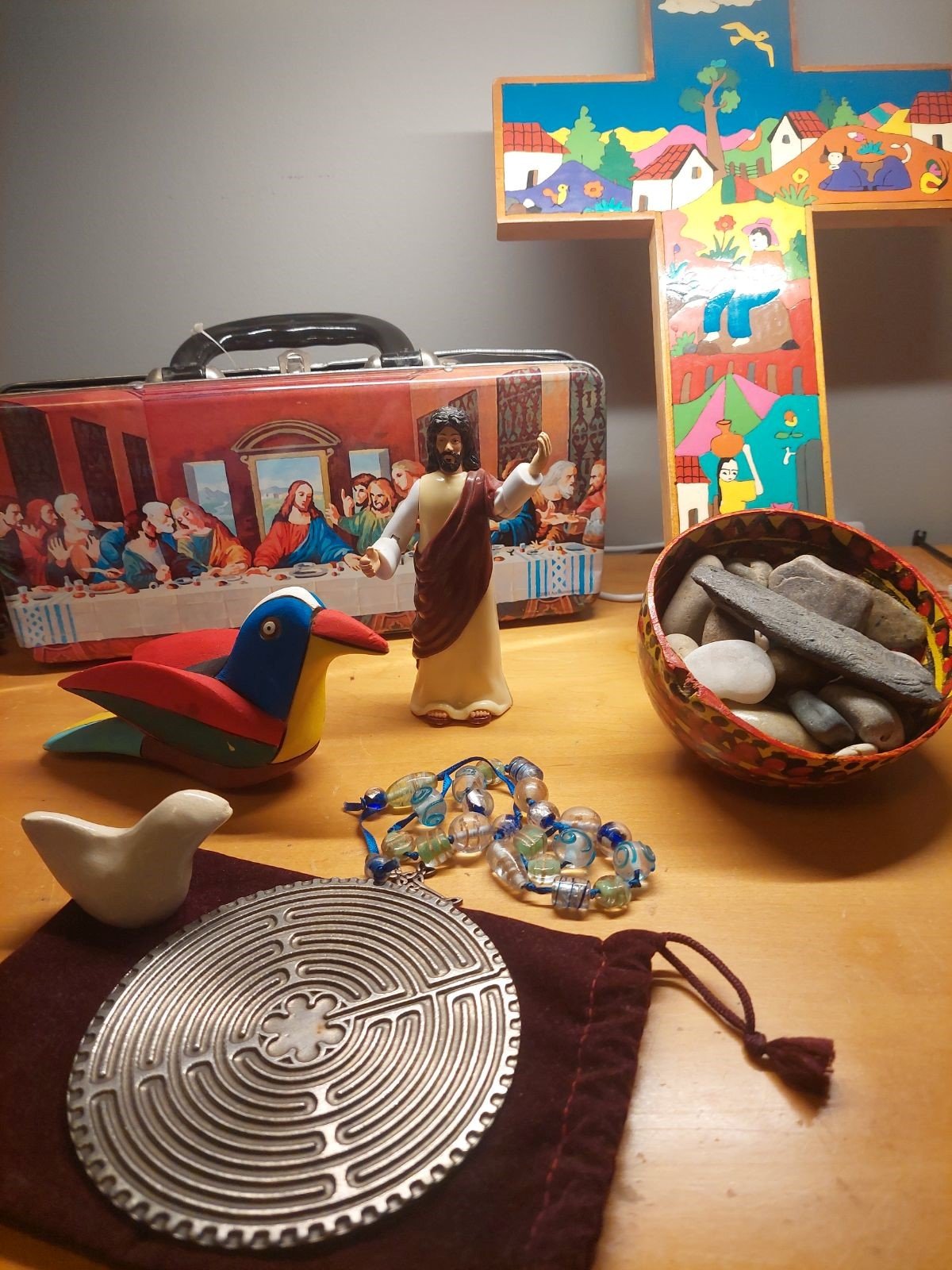
My Jesus Action figure. I’ve had him since my early days as a Chaplain at Mount Saint Vincent University, and he has traveled with me many times. His only official tricks are that he glides and blesses – which, if you can only do two things, gliding and blessing are pretty much right up there. Close companion is the Jesus Bobblehead. And my prized possession, my Last Supper Lunchbox.

A collection of rocks. Some came from Lake Huron, a place where I spent many summers in my early years and still visit. Included are my small collection of rocks with holes in the centre, and my heart shaped rocks that I have found or was given over the years.                                                          

Two birds. The coloured one is from Solintename, Nicaragua. I bought it when I was in Managua, Nicaragua in 1997 with my class from the Centre for Christian Studies. The Gospels in Solintename are four volumes of transcripts of bible studies in the early years of the Nicaraguan Revolution. They document the liberation that comes with community engagement, conversation, and the stories of Jesus.

The little white bird is from my spouse Pat, from New Orleans.  Part of the BirdProject, it came encased in black soap, also shaped like a bird, made from Louisiana Clay. As the soap is used, eventually the ceramic bird inside is freed – a symbol of restoration and recovery from an oil spill disaster. This also reminds me of the power within, and how we all need the help of others to be restored and whole. It also has a bit of a chip on its beak. That happened in my hurry to free the bird from the soap. It reminds me that sometimes we often have scars, bumps and bruises from our experiences. It’s who we are.

A wooden painted cross from El Salvador which I bought at Phoenix Rising, an international interfaith university chaplains’ conference in Vancouver in 2000. I am not usually drawn to a cross as a symbol of my faith, but these beautifully painted crosses from Central America, with scenes of people and landscapes, and community, are symbols of life.

My hand made prayer beads, which a colleague and close friend taught me to make, and which I have in turn taught other groups how to make 

A finger labyrinth, which reminds me of life’s journey, with all its twists and turns.

These items have traveled with me over the past 35 years, sometimes spread out between 2 or even 3 offices. They traveled to Toronto and back. I wasn’t sure what to do with them when I looked at them last fall when I unpacked. It appears that they will have another home for the next year.

What helps you to remember the “God moments” in your life?