
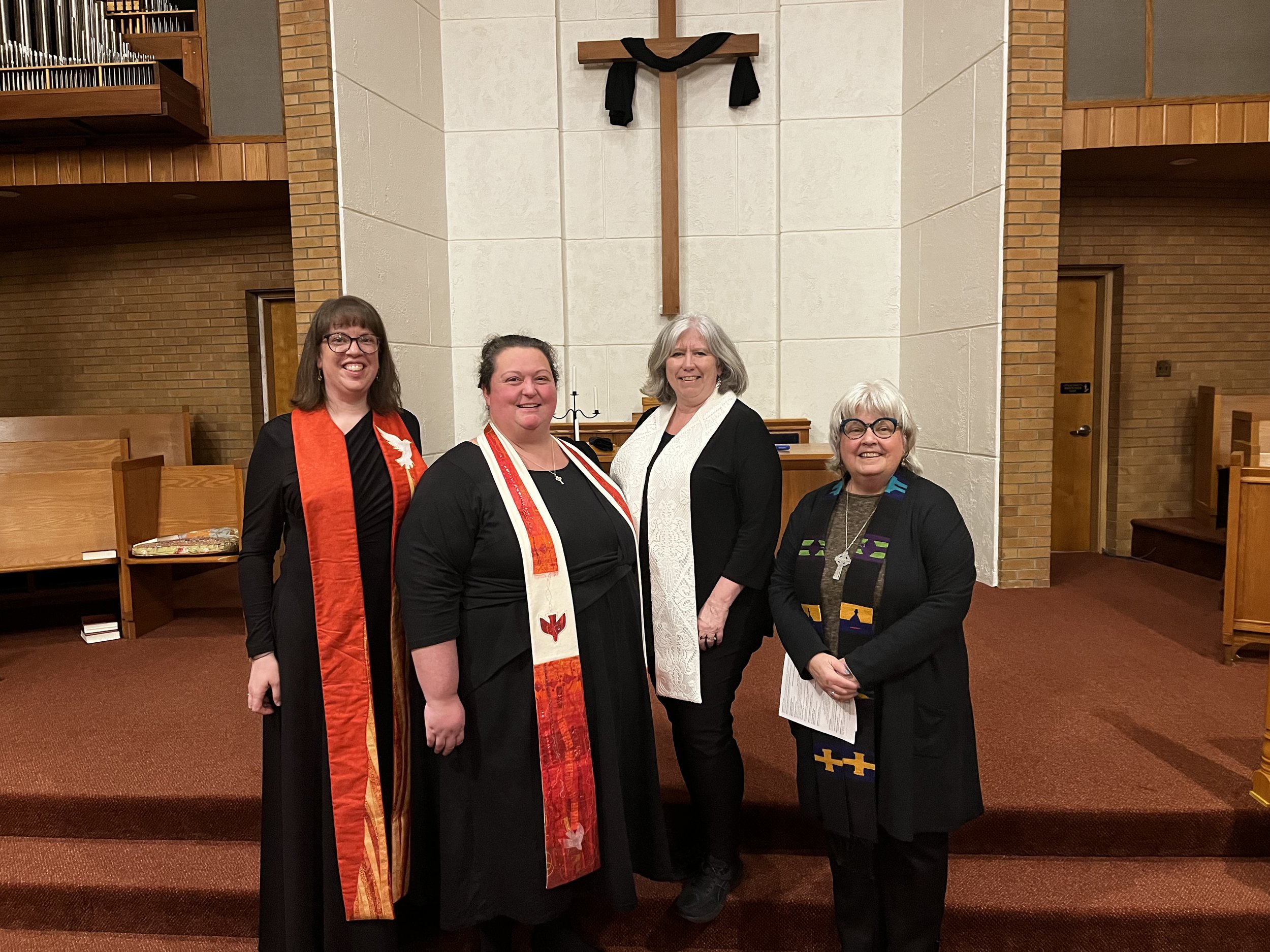
This is a picture of myself and the three clergy from our neighbouring United Churches, from left to right, Rhonda Schofield from St. John’s, Kathleen Anderson from Hope, and Angela MacLean from Hillside, after last night’s Good Friday service at Bethany. Although it had been a very serious and contemplative service, It’s possible we were all smiling because the service was over. Perhaps they are smiles of relief. And companionship. It is no small task to plan a joint service with participants from four congregations, but from the feedback it looks like we are getting pretty good at it.
The music from the massed choir was spectacular. At the end of the service, which was an adapted liturgy from Sanctified Art, it called for a “strepitus.” I had to look that up on the google machine. It is a Latin term meaning a harsh noise, loud crash, or uproar, most famously used in the liturgical service of Tenebrae … to represent the earthquake that occurred upon the death of Jesus … generally created by slamming books or rattling pews.”
Shawn and I discussed at length how we might incorporate the “strepitus” into the service. In the end, we decided a loud noise on the organ would be the best option. I think it was very powerful the way it worked out.
Today is often called Holy Saturday … the in between time … in between Good Friday and Easter Sunday. When Jesus’ friends were stunned and overcome with grief. They didn’t know the end of the story, like we do.
This is a picture of a sculpture at the Spiritual Life Centre in Wichita, Kansas. Called “Resurrection”, it is made of Vermont white marble and African black granite. It was created by Jerzy Kenar and George Kurjanowicz, if you look closely you can see that it is actually a fountain – there is water trickling out of the crack in the granite slab unto the ground.
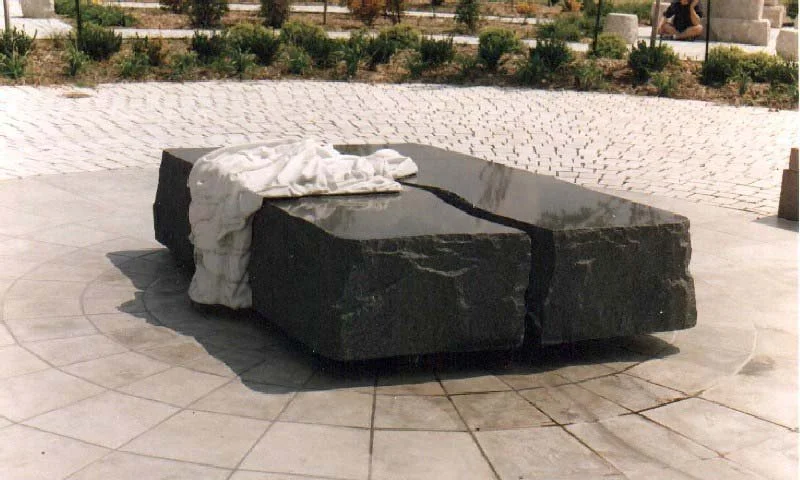
Professor Elizabeth Johnson says that … “In Matthew, an earthquake occurs at the moment that Jesus breathes his last, splitting open rocks and releasing the bodies of saints from their tombs … So also, an earthquake accompanies the descent of the angel from heaven to roll away the stone, witnessed by Mary Magdalene and “the other Mary,” … The shaking of the earth is an appropriate parallel for the way that the events of Good Friday and Easter morning shake the very foundations of everything once thought to be secure.
We have grown so accustomed to celebrating Easter with beautiful flowers and joyful music that we tend to forget what an unsettling, confusing, frightening day it must have been for those who first experienced these events. … The earth-shaking news of the resurrection is unsettling, even frightening; it shatters all our human attempts at security and jolts us into the unfamiliar territory of God’s new creation. In Jesus, the reign of God breaks open everything that seemed fixed and immovable -- even death and stone-cold tombs.”[1]
That’s why I love the picture of this sculpture. I first saw it many years ago in an Arts and Worship resource, and think of it every Easter. It reminds me of the full story.
And when you are ready for a delightful take on Easter by kids, I am reposting a video I shared last year of an intergenerational interpretation of the Easter story.
https://youtu.be/wdn1R90kX9A?si=vxBEED_T89fav6M4
Tomorrow we will gather (some of us at 6:45 am at Hillside!) to celebrate the good news that in fact … death did not win. There may or may not be a knock knock joke or two … and I’ll be addressing the perennial questions posed by 3 year old Isla in the following video …
Did Jesus like chocolate? Was the Easter bunny in the Bible?
https://youtu.be/4Xgk6g-ovjM?si=c2pZdxFh6x49Qq44
Blessings
Martha
[1] http://www.workingpreacher.org/preaching.aspx?commentary_id=3876